Artificial Intelligence (AI) is a rapidly changing and evolving entity. Search engines like ChatGPT, Claude, and Gemini are becoming an integral part of our daily lives, and most people use AI without giving it a second thought. Just think for a moment about yourself, how often do you mindlessly type questions that are easily answerable by either your own knowledge or a simple Google search? Everyone does it. ChatGPT, Claude, and Gemini are all considered Large Language Models (LLMs), which are designed to create human-like text by predicting the next word in a sequence. These LLMs have quickly become people’s preferred form of searching, due to their quick responses and simple language. What most users don’t understand, however, is the impact even one search has.
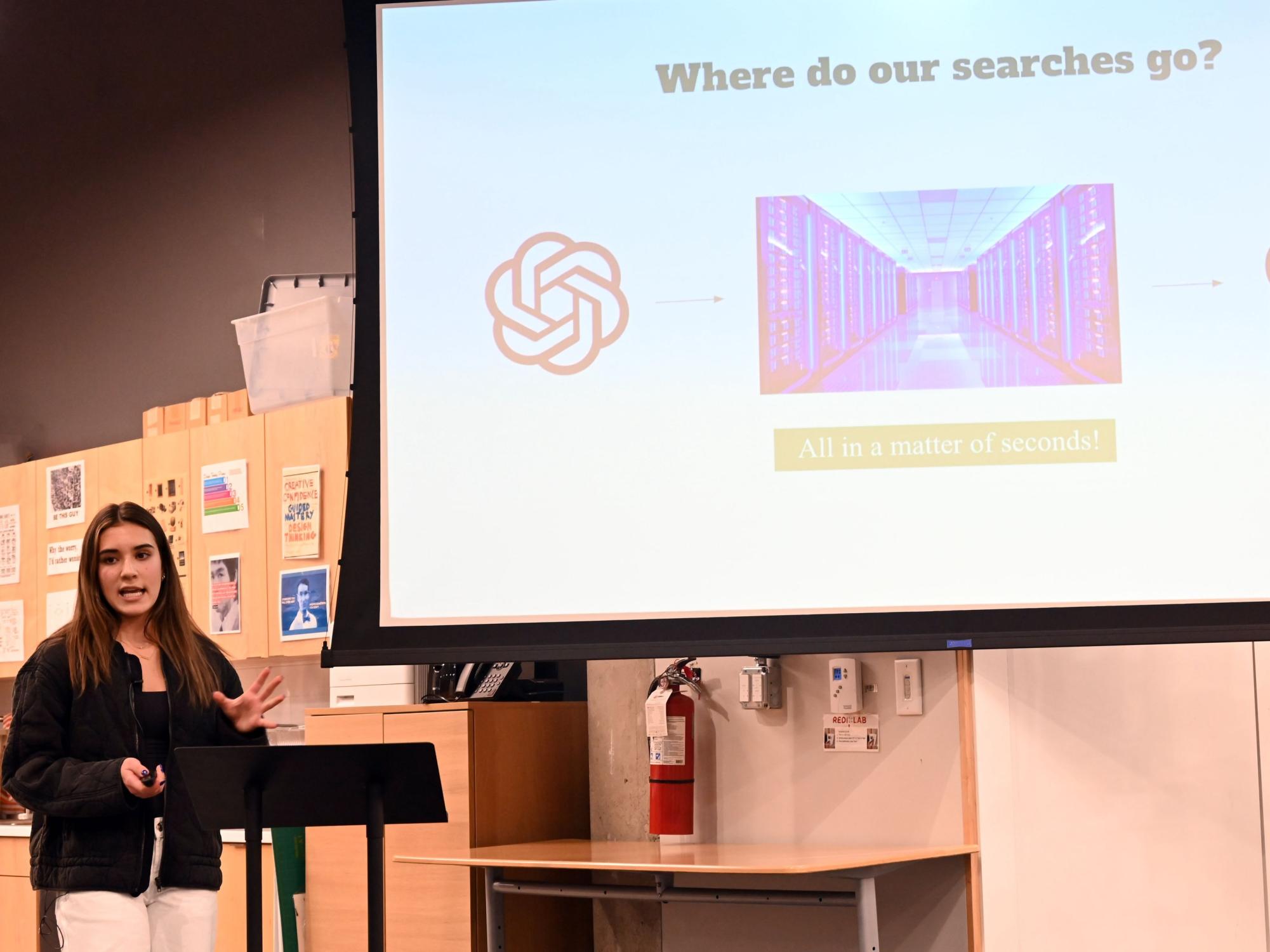
A common misconception about LLMs is that the computing of our queries is happening somewhere on the cloud or on our own devices. In reality, however, after we search for something on AI, LLMs process the information by sending it to internet servers located at data centers, and then once they have a response, they send it back to our device – all in a matter of seconds. It’s incredible! This process doesn’t come for free, however. What people often don’t realize about AI is the massive amount of energy it requires to run. Every time you use an AI tool, servers in data centers must process your request, which demands significant energy. This has increased the demand for electricity—energy that isn’t always available or clean. To meet this demand, we’ve had to burn more fossil fuels, and as a result, we’ve been releasing millions of tons of carbon dioxide, accelerating climate change. Take ChatGPT for example, a single search is around the equivalent of 0.3 watt-hours of electricity, which is around the equivalent of charging a smart phone for 10-15 seconds and having an LED lightbulb on for 1 minute. That may not seem like a lot; however, after multiplying that by the millions of queries LLMs receive daily worldwide, the numbers become astonishing.
During my time at REDI Lab, I knew I wanted to address this growing problem. My fascination with this new tool, mixed with my concern for its environmental impact, was the basis for my project. After some time deliberating how to fix this problem, I came to the realization that this project needed to be an awareness campaign. That’s when I came up with the idea to make a calculator. My idea was to make a product that could calculate the amount of energy someone uses based on the average amount of AI they use. In my calculator, I first ask a series of questions. These include: How often do you use AI? How long are your average searches? What do you use AI for? And, how many follow up prompts do you ask? Based on the answers, my calculator converts the values to kilowatt hours (kWh). I was able to do this by creating point values for each of the answer options and then multiplying that number by 0.005–the estimated number (in kWh) used for a single online search. The last aspect of my calculator is the conversion from kWh to metrics more understandable to an average person. Some of these metrics include: hours of a lit LED lightbulb, minutes in a microwave, and hours watching TV. My idea was that if people understood what their energy use meant in more easily understandable terms, they’d be more likely to reduce their use. For this project, my “Theory of Change” is: by raising awareness of AI’s energy demand through the creation of a calculator, people would be more conscious about their AI use, and help to protect the environment.
About three-quarters of the way through REDI Lab, I developed a second interest in something else AI impacts: cognitive health. Not only does AI harm the environment, but it also has a negative impact on the users. As AI has continued to grow, people have become lazy and overly reliant on it. Rather than thinking critically about things, people simply type information into AI, take the response, and call it good. We are actively losing the ability to think deeply about things, and it’s affecting our problem-solving ability. This led me to my second “Theory of Change,”: By being more mindful of our AI use, not only are we helping to protect the environment, but we are also relying on AI less and are improving our brain function.
My project and time at REDI Lab have shown me firsthand how AI is already shaping our world. For society to build a sustainable relationship with AI, we must first acknowledge its environmental and cognitive impacts and take action to address them. AI users need to become more mindful and responsible with how they engage with these tools. By doing so, we can ensure technology serves us rather than replaces us. As someone who believes their generation will inherit both the climate crisis resulting from AI and its advancement in the coming years, I believe it’s my duty (along with others) to push for change now, before it’s too late.